1. Pre-acquisition > 2. Acquisition > 3. Reporting > 4. Results distribution
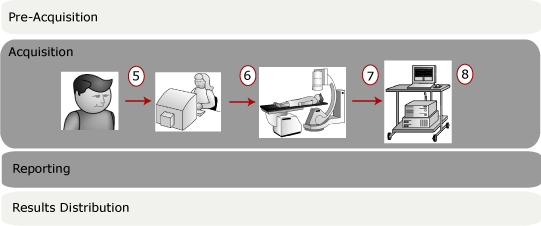
The acquisition phase begins when the patient arrives at the hospital for the study, includes when the technician "acquires" the study images, and ends when the study is sent to the PACS.
4. Patient arrives at hospital — patient admitted event
On the day of his study, the patient arrives at the hospital admitting desk. The receptionist takes the patient's information and enters it into the Hospital Information System (HIS) to obtain a unique identifier for that patient. The HIS generates a patient admitted event and sends it to the Radiology Information System (RIS). (At some sites, the event goes directly to the connectivity component.) The event message may contain updates to the patient information, such as the patient's address. This, in turn, generates a patient updated event. The connectivity component receives these events and sends patient updated events to the PACS with the correct patient data.
5. Patient arrives at the radiology department
The patient proceeds to the radiology department and reports to reception. The receptionist registers the patient into the Radiology Information System (RIS) if the RIS is not already updated by the HIS. The order for the patient is filled in the RIS and is assigned a unique identifier, or accession number, for that study. The arrival status of the patient signifies to the technologist that the patient is in the waiting room and is ready to be imaged.
6. Technologist "acquires" the x-ray —modality worklist query, study started and study completed events
When the patient arrives at the modality, the technologist requests a worklist that contains the patient information and the details of the study to be performed. The modality worklist query is sent to the connectivity component, which responds with the most up-to-date patient and study information that it has received from the RIS. (The modality speaks DICOM, and the RIS and HIS speak HL7, so the connectivity component is required as a translator.)
When the technologist begins the x-ray, the modality sends a study started event to the connectivity component. This event is part of MPPS communication. When the study is completed, the study completed event is also sent through the connectivity component, to the RIS. (The RIS is always the final storage location for study information.) The connectivity component can then send study updated events to the PACS.
7. Technologist does a quality check
The technologist performs a quality check on the images, then forwards them to the PACS for storage.
8. PACS receives the images and performs HIS verification
The PACS verifies that the images received from the modality match a specific patient. This process is called HIS verification. The PACS sends a query to the connectivity component that normally asks for a patient based on the patient ID and accession number. If the connectivity component returns one patient, the study is verified and stored. If more than one patient is returned, the study is marked as unverified and must be verified manually, usually by the PACS administrator. Numerous fields relating to patient and study information are also checked and updated if differences are found.
1. Pre-acquisition > 2. Acquisition > 3. Reporting > 4. Results distribution